The Film-maker’s Pilgrim Tale

So retracing my steps along this meta-physical road, from my start in 1991 with seeking a place that may never have existed (Camelot) to one that definitely has and does to this day (Canterbury), has left me wondering about what makes or made either road appealing – and especially to some attaching a special significance to one, the road to Canterbury, such that it is known to this very day in the UK as The Pilgrim’s Way

The other, alternative road – interestingly enough – has no name, and so I shall just call it “The Alternative Way“. 

Ironically, it was the latter I took in 1991 as it seemed more interesting at the time with the mystery of the Arthurian legend as well as the younger and more alternative people on it – but then maybe I did not look closely enough at the other path to see that there was perhaps more to it than met the eye?  Still, I did not really know much about Chaucer back then and feel any real connection with that road – unlike now.

So, in considering to take what looked to be the well-worn path – and so daring to understand more about pilgrims and pilgrimages,  this Sunday past I met with a film-maker who has recently made a pilgrimage to Tibet – and made a film about it, of course! 

Prologue

By the way, I guess an interesting part of this meeting is that I did not actively seek her out – I sort of just bumped into her in the street through the acquaintance of a mutual friend and recognised the coincidence of the pilgrimage theme that we have in common.  This chance crossing of paths with people who had chosen to travel down the Alternative Way was typical for me back in 1991, and helped prove to me that I was on the right track to whatever it was that I hoped to find – although often that was never totally clear either. Still, it was my fellow travellers’ stories that often led me on to finding interesting places and interesting people…

Now, with deciding I am definitely ready to follow the Chaucerian road to Canterbury, I am starting to meet a lot of those others whose paths seem relevant and who have equally interesting stories to share (and share I/we shall! 🙂 ). For some reason, I did not meet any of the Canterbury road people when I tried to work out where to go in 2006 – but, happeninstance is that now, I am finding people who not only know the road but are seeking to make a pilgrimage all or part of the way to find something in themselves from it. 

It’s just these people are not necessarily found in the literal places that you’d expect to find them.  Although it does not help that many of the literary places, t’auld coaching inns, no longer exist!    

So, to get on now with the Film-maker’s Pilgrim Tale

(and, yes, by now you will realise that I never tell the others’ full story myself – but instead allow you to surf your way to wherever links in here, or Google,  lead you – and eventually on to my book about it, of course! lol)

More or less the first thing that she said was that her next journey is to find her way back to a temple high up in the Himalayan mountains that she never got to see inside, yet which she knows instinctively there is something special inside for her. 

How she will get in there she does not yet know – but it will not just be her experience alone in doing that, as she is seeking a few fellow pilgrims to join her. 

She is wearing a very stylish summer dress and bangles, as she recounts her most recent experiences that have led to her decision to take this next journey (and yet another pilgrimage).

With the curious tattoo on her left shoulder – that I cannot see properly, I get the feeling that I am meeting someone more like “Lara Croft” – and an adventurer or explorer – rather than someone suited to an internal journey of self-discovery and a respecter of the sanctity of other culture’s holy places. 

However I dismiss such silly schoolboy notions from my mind about what she might really be seeking – and try to make sure that I am focused on spiritual riches, rather than material or physical ones. 

So I ask her what a pilgrimage is for her. She tells me that she takes it from meaning of the Sanskrit word “yatra“, which she states as being a word derived from two parts: 

ya –  a journey, or travel and moving

tra – protection

Put those two together and it refers to travel outside of one’s familiar environment to encounter a moment of “purification”. 

Once that purification happens then one can have an experience of “heaven” or, to put it more metaphysically and agnostically, a pure experience beyond one’s self that cannot be explained.

The end-result has been often described traditionally in one of two ways:  spiritually or personally.  The first, as she explains it to me, is “connecting with one’s soul” and t’other as more simply “coming into one’s self“. 

Interlude / Intermission

Either explanation seems fair enough to me – but perhaps I am a little biased from having had experiences like the one I had on Aghadoe Heights in 1991 above the shores of Lake Killarney in Co. Derry, Ireland.  

Even now, I still question what I felt on that misty morning in May – and on other, similar moments in time that I have had earlier and later in life (and not just on my own, but with others too). 

Did the Killarney one come from something outside of me, that brought me to tears for no apparent reason at all (at all), or was it simply from a previously untapped inside of me that wanted to leap out like a little gleeful and beguiling  leprechaun and take away my self-control so that I would happily jump the brown log fence, run madly across the luscious green grass of the field – with the two chestnut horses nose-to-nose in it – and, down the mountainside through the fresh morning dew, to dive – perfectly mind you – into the placid and mirror-like waters of the grey, green lake. All safely explained afterwards by a sudden desire to catch those darned water nymphs who have beckoned me there with their keening call and their beautiful, green, intelligent and glowing – yet fish-like – eyes.

To be sure, that brief moment felt like being drunk – but without having had anything to drink! 

Not that I am saying that I mind having an inner leprechaun, mind you – as I do like to believe in something more than just me and thee, as well as in helping others’ wishes come true.  Just don’t try yer luck too often wi’ me, laddies and lassies, OK? 😉 

Seriously though, that personal experience of bewonderment at all and everything you have been allowed to see in that one glorious moment is truly exhilarating, no matter how you want to explain it. It is something that I feel no one should go through life without once feeling – or perhaps “touching” (if that is the right word). 

End of Interlude / Intermission

So, following my little reverie (which she has kindly allowed me to have), she then asks me whether I meditate.  Sort of, I reply, and give a rather sheepish account of what I do, occasionally, to shut the rest of the world out and bring the rest – as in peace and quiet – into me.

Om“, I also say – to which she gives a textbook explanation, that catches me by surprise, about it being the Alpha and the Omega in Sanskrit – the beginning and the end – and a key thing to say when getting oneself into meditational state.

Ah“, I reply hesitantly – and unwittingly – not realising that that has a special significance in Sanskrit as well, as she duly explains.  So perhaps I am an accidental meditator as much as being an accidental pilgrim? 

Certainly, as we then discuss (although I must admit to feeling nervous now), it is great to feel that one has gone beyond the plain, ordinary level of being, to being outside the everyday self. 

To achieve a good meditational state is like suddenly there is a better feeling, she advises.  To go beyond that, to the state of purification that one feels at the end of a pilgrimage, is better than to simply “be alive” – it results in one feeling an ultimate joy, if not closer to God.   

“Others, from different backgrounds and cultures, might call it something else”, I state, to put things in perspective, “but I believe that nothing should be taken away from them for feeling that, as there is still something ‘universal’ about it for me”. That’s the best that I can call it without starting to sound too much like I, myself, am preaching (and without even knowing what I am really preaching about!).

My film-maker friend calls it “eternal“.  We both agree that it is a feeling of something that connects all of us, and especially with those who have felt it, and that it is something that deserves to be shared with people from all cultures and anywhere – including with those who have never experienced it, but are still happy to chat about it. 

Of course, when you are high up in The Himalayas then it could just be a result of being starved of oxygen!  Then again, trying to figure things out scientifically is what can be part of the issue in trying to understand that feeling you’ve experienced from finding what you have travelled for, sought and found, or otherwise achieved from simply making the journey. So perhaps, Lhasa or somewhere in Nepal, here I come? 

As we come back down to Earth from this sharing of amazing feelings we have each had, and experiences of diverse places that had them in, we come to a mutual agreement that we want to help others with daring to consider going down that path to find and have just one of these moments at some stage in their life – as the beauty of it all, we agree, is that it is something in the end that you want for others too.  It is something to be shared, even if the experience is so personal that it cannot be fully explained.

So, at this point in the conversation with the good lady, I am reminded once again (but don’t ask me how or why – lol!) about Robert Frost’s poem “The Road Not Taken“,  which is  from a collection of poems he compiled – perhaps poignantly given setting of The Pilgrim – under the title “Mountain Interval“.

It sums up decisions in taking the road that one did not take, and a lot of what Matt’s Tale (this blog) is now perhaps daring to become more and more about:

TWO roads diverged in a yellow wood,

And sorry I could not travel both

And be one traveler, long I stood

And looked down one as far as I could

To where it bent in the undergrowth;


Then took the other, as just as fair,

And having perhaps the better claim,

Because it was grassy and wanted wear;

Though as for that the passing there

Had worn them really about the same,


And both that morning equally lay

In leaves no step had trodden black.

Oh, I kept the first for another day!

Yet knowing how way leads on to way,

I doubted if I should ever come back.


I shall be telling this with a sigh

Somewhere ages and ages hence:

Two roads diverged in a wood, and I—

I took the one less traveled by,

And that has made all the difference.

Epilogue

For me, Robert Frost is aptly describing the difficulty of making the decision to take EITHER path (hence TWO, is deliberately in capitals, at the start), and not just progress down a more well-worn route that others have clearly trod.   

The look of those two roads will be different for everyone, based on their own culture, conditioning and upbringing – as will be what they experience at the end of either, but how many will ever return to take the other road in one lifetime if ever?  ‘Twill be with a sigh…  

To start with in comparing journeys for myself alone, I am looking to learn more about what the difference is with Jonquil’s journey from other  journeys I’ve taken and to this one that I am now taking (but just not as far).  This will be done through seeing either one of the screenings of her film, either on Sunday, 8th May in Camden bookable online through Alchemy The Centre, or on Sunday 15th May in South Kensington bookable online through Evolve Wellness Centre

The movie is called The Pilgrim – click on this link to get an idea for yourself from a promo clip.  Leave a comment if interested to come along and what day you’d be heading there.
Posted in Camelot, Canterbury, Chaucer, Film-making, Himalayas, Pilgrimages, Tibet, Travel | Tagged , , , , , | 5 Comments

The Big O.E.

I don’t know what prompted me to decide to write up my stories and discoveries about England and Ireland now, twenty years on from when I first set foot upon these shores, because surely I would have had ample opportunity earlier.

Some people have a clear plan for their holidays and travels but, back then, I didn’t.  However Overseas Experience, or O.E. as we liked to abbreviate it to in New Zealand (and presume still do?), is not just like a regular holiday where you travel away somewhere with definite days on when you leave and return as well as a rough, if not definite, idea of where you’re gonna stay.  

Rather, the working holiday is one where you disappear for anything from one to up to five years or more – according to the generousity of the foreign nations, who you decide you want to live and travel in, accepting you with the requisite visa.

In my case back then in 1991, that visa was called a working holiday and young people from New Zealand (NZ), under the age of 28, were able to come for two years and work up to half of that time and travel for the other half.  Reciprocal arrangements worked between the two governments in the other way, of course, and so I guess the scheme governmentally amounts to some kind of young persons’ exchange programme.  Perhaps scarily, I have not thought too much about it up until now – apart from the fact that I just made it here in time to the United Kingdom (aka the UK) before my 28th birthday, along with a hot £1500 (or was it more?) in my hand and so sufficient means to get started on finding a base and travelling here – or return home to NZ if it was not working out.

So that, really, was the extent of the plans to get away for a year or two.  A sufficient wad of cash and a right to work somewhere else while living it up through travelling a little.

Somewhere along the line though, my working holiday went from being something that was just an extended holiday to being a bit more than that.  Weirdly, I wasn’t even conscious of it at the time I first arrived in the U.K. – but perhaps if blogging or other ready means of communication was available to keep in touch with friends and family back then, then would I have discovered it earlier?  Moreso, perhaps, if I kept a regular and more reliable journal – as I noted some did – but then  who knows if anyone ever gets to read those again, including the people who I noted (often religiously) writing them?

The thing is, the Big O.E., as my friends and I liked to call it back then, was just something that you went and did for a year or so and then returned home.  Somewhere along the way I think I crossed the line, as the more I travelled, the more I wanted to go further.  There was a name given for this back then:  backpacker – however I did not always travel with a backpack on my back.   

I was not a traveller either, as the word “traveller” has a different connotation – and was one that was reserved for what had once been a band of nomadic people, primarily known as gypsies, who had no fixed home and wandered from one place to the next according to some code for a way of life.

Yet that was not me either, as I was happy to be in one place for a while, and then discover things about the places around it – as I did in London for two years – however, after that, I was interested to go further and discover something more.  Seeing how far I could travel overland in 1993, and whether I could make it all the way back to Australia without flying, was the first full test of that travel bug I had caught.

It was hardly a holiday as much as a journey, and I was not exploring, as the places were not new, just not frequently travelled – although part of the travel was taken with a company that did expeditions as far as India and I wish now that I had had the courage to take that part of the journey on my own.

It was just something I wanted to do, following instincts of where it would lead me and learning something new.  Since discovering about how I have accidently travelled on The Pilgrim’s Way when I first came here, I have wondered whether I was, in fact, some kind of accidental pilgrim – but I would hesitate to call any of these journeys or travels a “pilgrimage”, because it’s never been clear to me when and where I do things that there is something more in it beyond “me” – however I have met people who consider their journey to be one (and see blog that follows on that).

Yet for me, a journey is different to a holiday as it is one where I’ve taken time out to go somewhere to find out about someone or something that means something to me – but what is it that would make that journey be seen to be something more than that.  What makes it a “pilgrimage”, and one go on one – like those travellers in Chaucer’s Tales were supposedly doing all those centuries ago and many do today on the road to Santiago de Compostela in Spain?

I am beginning to wonder now whether I was an accidental pilgrim, either all those years ago or in 2006 when I decided to retrace my steps.  The thing is, it all began with finally deciding to take the Big O.E. – and so I have my friends to thank for encouraging me to finally do that, as well as the governments of New Zealand and the United Kingdom for making it possible then (as they do now). 

However what do I do with what I learned, and where am I supposed to go now?  Maybe a mid-life or mature life O.E. is required, friends and governments – or is that what is meant by “taking a sabbatical”?  Unfortunately that sounds very academic and holy to me – and like I have to have some form of intention now.  So who makes up these general formulas for people and citizens to follow or take at various points in their lives?  Coz that’s perhaps who I need to talk to right now!! 😉

Posted in London, Pilgrimages, Travel | Tagged , , , , , , | Leave a comment

The Supply Chain Planner’s Tale

I met a man with a plan last weekend, whose stories and ways reminded me of Chaucer’s Merchant and his tale – but maybe we all have some aspect of those characters and their stories in us today?  You decide, starting with what Chaucer had to say:

There was a Merchant with a forking beard
And motley dress; high on his horse he sat,
Upon his head a Flemish beaver hat
And on his feet daintily buckled boots
He told of his opinions and pursuits
In solemn tones, he harped on his increase
Of capital; there should be sea-police
(He thought) upon the Harwich-Holland ranges
He was expert at dabbling in exchanges….

The Prologue, The Canterbury Tales
Geoffrey Chaucer, c 1391

So what characters are you likely to meet on the road to Canterbury today?  The prologue of the Canterbury Tales tells about some of the ones that Geoffrey Chaucer met – and for some reason the Merchant, with his Flemish beaver hat and daintily buckled boots telling of opinions and pursuits, stands out in my mind as one of the more interesting ones.

The tale that the merchant chooses to tell is not one of trade upon the Harwich-Holland ranges but rather one about the marriage of an elderly merchant to a young girl, who subsequently betrays him with a younger lover – something that the sugar daddies of today should perhaps bear in mind when seeking to be seen as silver foxes.

As fate would have it, last weekend, 9 April 2011 – a warm spring day, that tempted me to think of the sweet scents and sun of May – I happened to meet a Supply Chain Planner who works for a shipping company here in Canary Wharf, London, and not far from where Chaucer would have come to his second or perhaps third pub stop along the way to Greenwich. 

Sadly, it was not there in Greenwich that I met him (although I will find the pub there at some point) – but at the Toastmasters’ Division B finals of the International Speech competition at the Royal Veterinary College’s rooms in Camden (and, believe me, some of the, er, massive turd-like exhibits in the museum there are something worth seeing in themselves). 

It was a day for ironic and uplifting tales, as it happened, as seven contestants told stories about mixed personal trials and triumphs (often both in one).  Their competency in recounting these experiences was with a view to, ultimately, winning a place in representing Britain and Ireland at the World Toastmasters’ Championship.  The winning stories included ones about dragon-like mother-in-laws, with princesses hidden inside, and relenting stepmothers – but the final winner was one who told a speech from the heart about his rescue from the clutches of death – and perhaps prospect of never walking again – where he was reassured by a simple smile, in the face of this adversity, into realising all was not lost.

Given Toastmasters is all about being able to stand up and speak well before an audience, it is probably one of the closest organisations we have today that perhaps parodies weekly, at a range of different clubs located at different places around London (and often in a room off the back or side of a pub), the type of tale-telling that Chaucer encouraged his fellow travellers to do as a source of amusement on their way to Canterbury. The beauty of it is that it is all about finding ones’ voice – and perhaps self in the process – through being able to tell a good tale well as much as make a speech. That is perhaps a whole part of the journey in itself for some.

Tis not Toastmasters that is the tale to tell for this day though. Rather, I believe ’tis that of the Supply Chain Planner, the man I met through St Paul’s Speakers , and the one who kindly allowed me to sit with him and his beautiful young lady friend who attended this day’s competition with him.

Although he was not wearing a Flemish beaver hat, there was just a hint of the ornately dressed Chaucerian merchant about him as he mentioned to me about how much an image can make a difference in standing up to talk – possibly also because, once again (as I have been caught out before), I was not as well attired as I perhaps ought to have been for the occasion.

Still my dress sense was not so bad as to prevent him from  heading out with me after the competition was over, along with one of the good knights from the previous weekend – Sir Dave Longley as we shall now dub him – who had been a judge of the day’s competition.

The idea we had was to go on to see the delights of Camden, as this is somewhere that I have had the good fortune to get to know in my single man’s days, and he admitted to me that he was keen now – as getting a little older – to meet the young lady of his dreams.

Still, there was perhaps, in a way, a hark back to the original Chaucerian Merchant’s story in our journey that night – as we did manage to meet a young teacher or three, thanks to Sir Dave’s spillage of the beverages compelling me to pass the hand towels past them to clean it up and my friend realising the opportunity to talk to them.

Sadly, holding the attention of these three fair maidens was not something we three were able to do – perhaps parodying in one night, what the Merchant’s Tale tells about those who cannot see and remember their age and how that might be seen through others’ eyes.  In the messy process, I also realised that my days of having fun, in such noisy pubs and clubs at least, are now well done.

Of course, perhaps if they had served White Knight ales there – like they did at The Tabard that weekend before – then it would have been a different story for helping fulfill the orders of our younger supply chain planner friend.  Then again, perhaps our friend simply needs some younger and more adept companions to help wing him on his way to sharing vows with some angel at a church or cathedral somewhere. 

However whether those vows would be made in Canterbury, or some other place, is a whole other story for another time.  There is probably more yet to this story – where either the angel or the demon will out herself – however I will need to consult the good supply chain planner himself on what he remembers from the night. 

Certainly some wisdom on’t was shared, and surprisingly not unlike that shared by the Merchant those 600 years ago.  So, on this road together, as we head along the way – and perhaps some time poignantly in May, the Supply Chain Planner will not fail, and tell this or a later adjunct, to complete this little tale….

Posted in Camden, Canterbury, Chaucer | Tagged , , | 1 Comment

The Nanny’s Tale

Never judge a book by it’s cover

Unknown origin

Last Saturday night, 2 April 2011, I met up with some others who I have met in my journey back along the road I chose not to travel when I first came to the UK in 1991.

That road is the one from Winchester to Canterbury that I now know to be The Pilgrim’s Way and, perhaps now even better still, as the road associated with the pubs from Sir Geoffrey Chaucer’s Canterbury Tales.

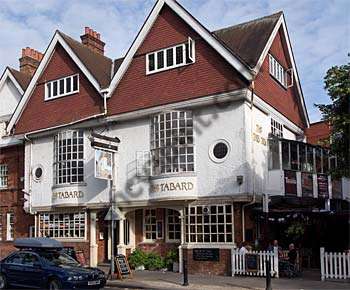
Indeed, to get as close as we could to what relates to the road that’s here nowadays – rather than what is still there from Chaucer’s day – we met at The Tabard, a little pub in Acton named after the pub that Chaucer and his fellow travellers first met at.  The first Tabard, set in Southwark, no longer exists – and, in my mind, there are too few pubs in that part of London that really create the atmosphere that might have existed in Chaucer’s day.

The Tabard in Acton, by contrast, has a great atmosphere that embraces its local community and is perhaps more true to being a real alehouse than many along the actual road these days.   

those who want a place to share tales and a few real ales in a similar atmosphere in Acton

The Tabard, Acton

So it was there myself and a few others met to compare stories of how we came to discover this well-worn road – and I realised, by contrast to their stories (which hope to pass on), that mine is probably less interesting due to being such a late and relatively boring discovery from simply reading up on the background of a BBC TV series on it that there was a connection in the book with the places where I first travelled in 1991.

A strange thing did occur to me that night as we talked about it: 

Chaucer did not tell a tale, nor describe who he was and what he did himself – yet he did describe each of the tale tellers in detail and titled each of their tales based on what they did.  Yet it’s perhaps significant that the tales themselves bear no relation at all to the teller.

 So hold that thought, for I have a tale on’t from events that unfolded!!

 It was later that night, after this first gathering of pilgrims and travellers on the road of the Canterbury Tales, that two of us went on afterwards to see what another pub was like in that part of Chiswick. 

 It was the big 6 foot 5 inch, wiry and blonde-haired John, and I, the rather portly and balding 5 foot 7 one, who ventured forth into the bewitching hours of the night as The Tabard wound down its welcome for the evening.   To be as honest as possible about it, it was perhaps more akin to Friar Tuck and Little John, out of The Tales of Robin Hood, heading out on the town together – if we are to liken ourselves to anybody and reference classical literature to do it.  Anyway, our actual day jobs sound boring by contrast – so let’s NOT let them detract from the tale born of too many White Knights that is to be told here (or perhaps foretold?).

Coz, yes, we had both imbibed quite a few real ales earlier at The Tabard – and one in particular called White Knight.  I did think about trying a pint of Doom, although – given how I subsequently felt on Sunday after all those White Knights – I’m glad I didn’t.

 Nevertheless, it was spurred on by those auspiciously named ales that I agreed to let John introduce me to a local Blues bar he likes there in his “manor”, as Brits often call the neighbourhood they live in. Twas there, perhaps spurred on further by a more common real ale by the name of London Pride, that we encountered two damsels in distress due to some overly keen men foisting their attentions on them.

Feigning familiarity, we (somehow) fooled the gents into thinking that we were the ones that they had been waiting for – which seemed to do the trick in moving the less likely lads on.      

Now, bearing in mind the rarity of finding people like I’d just met earlier that evening, I was not really expecting to find anyone likely to know a lot about The Canterbury Tales. Even less so, when we found out that the girls worked as nannies. 

Nevertheless, they were as curious about us and how we came to know each other and be there – as we seemed to them to be an unlikely pair to be there, given our disparity in sizes. So, not expecting them to know about it, I decided to tell them.

To my surprise, one of the girls – whose name is Petra – not only had heard about the tales back home in her native Slovakia but also about a rumour that they parody stories told in Europe by one Boccaccio Dekameron.

Moreover, it turns out that she is also interested in these sorts of stories and the experiences that people have along the way.  This surprised her friend, as much as it surprised me.  Suddenly the cover of Chaucer’s book dropped on me, as well as a curious insight into why he titled his stories so.  They tell the tales that can be heard from, as much as appreciated by, Everyman, and perhaps much more than just knightly deeds popular in the court of his day.  So clearly Chaucer was very down-to-earth and appreciated others like that too.

So it is now clear that, if living by Chaucer’s classification of pilgrims, that there must be a Nanny’s Tale told in the new modern world.

 To be sure, it will not necessarily be one about changing nappies and chasing children – just as The Miller’s tale did not talk about baking his daily bread nor the Nun’s Priest tale, set on April Fool’s Day, tell about a sermon instead!

Nay, the Nanny’s tale will likely tell us more about the nave rather than nature of the teller – and about something they know to be true and encourage us to venture on further

So perhaps, with now knowing this, I can now move on further on with this quest.

Of course, being someone with the last name of Miller, I could be just telling this in jest!

 😉

Posted in Canterbury, Chaucer | 3 Comments

The Resonance of Arthur

The majority of those travellers that I met in Winchester back then were fascinated by the legend of King Arthur.

Similar to me, they had decided to start their journey in the ancient capital of England, but were as much drawn there by the legend of The Round Table and The Great Hall.

Perhaps a little sadly, I discovered 15 years later that these aspects of the legend were more born from the hopeful imagination of one Thomas Malory and a book he wrote “Le Mort d’Arthur”, telling the courtly deeds of the king and his knights – and incorrectly basing the legends there rather than 100 miles to the West in either Somerset or Wales (as even his printer, Caxton, is supposed to have suggested).

Still, the legend is over 1500 years old about someone who rose to lead the British people to defeat their Saxon overlords at The Battle of Mt. Badon – but what resonates is more than just the distant sound of a battle cry, and more that of moving to the beat of a drummer different to that of more traditional leaders who had led people to battle through threat of force and press gangs.

So how and what made the beat of this leader’s drum different to that of any other – and even to the extent that it is heard today?

The story seems to centre on the virtues of genuine nobility in performing deeds of selflessness that assist others and treat everyone courteously, if not equally.

Moreover, the legend of Arthur instigated the hope for anyone to attain the heady heights of nobility and become a knight, something which is reflected in the ceremonies on the Queen’s birthday when someone is recognised for their achievements and contribution to society.

It perhaps goes beyond that though, to the acceptance of both an individual person’s rights to achieve and believe – perhaps leading to, at a minimum, the opportunity for every Englishman to have their own castle (as is now possible with freehold as opposed to leasehold property).  OK, so I have to do a little more research into whether all these good things – and more – stem from the virtues and values of the good King Arthur.

Que sera though, the legend lives on and the principles serve to inspire all of us to better and greater things – and good deeds as much as acquisition of resources. 

How much more is needed than that though?  This seems to be the thing I am discovering from the intersection of the two roads, from Camelot to Canterbury.  Indeed, from whence to where does the direction go?  Perhaps it is now more back towards Camelot in this more ethically oriented and sustainable world we now live in – where things are, perhaps rightly, focused on what matters for helping the individual as well as the environment in being the best they can be.  What more do we really need and want beyond that?

Posted in Camelot, Canterbury | Tagged , , , | Leave a comment

In the Beginning, there was the word

In the beginning, there was the word.

How much different would history have been for the accolytes picking up on it, if that word was meant to be “good”, but was written down instead as “god”?  How much difference would a letter make to what people would then believe and even follow in how they treat each other and what they do in their lives?

At some stage in the Dark Ages of early Britain, between one set of conquerors leaving their conquest behind them and another set of conquerors coming in to claim it, there is the legend of a king called Arthur who claimed the right to bring people together and defend them from new marauders coming in to take over the land.

The question of how he claimed his right to rule is written down in a Latin text as having taken a sword from a stone.

Consider this however.  One of the Latin words for stone is “saxum” – and very similar to “saxo” the word for Saxon. So, just for argument’s sake, what if the Latin scholar made a mistake in use of the noun that describes where Arthur got his sword from, so that is really a who rather than a what.

So what if Arthur came by the sword that proclaimed his right to be king through taking it from a Saxon rather than from a stone?

How much less powerful, especially to the people of medieval times believing in magic, would this practical claim to the crown be over the rites of claiming it through a mystical one. 

Suddenly, for the want of a word – and the right one – a king’s right to rule becomes magical rather than traditional.

So perhaps the mistake was simply perpetuated, masking the real truth and creating a legend.

Posted in Camelot, Publishing | Leave a comment

April 1st, no fooling

In some places still, there may be people unwittingly celebrating the start of the medieval year right now – and giving each other chocolate fish. Perhaps in France, where they would be commemorating the change in the start of the year to January 1st, as decreed by King Charles IX. Presumably.

However perhaps they would truly be the April fools if, on the other hand, the origin of celebrations of foolishness on this day originate from the Nun’s Priest’s Tale, as told thus in Chaucer’s Canterbury Tales, about a sly fox and a foolish cock:

When that the monthe in which the world bigan
That highte March, whan God first maked man,
Was complet, and passed were also
Syn March bigan thritty dayes and two

The simple fact is that both (and more) are probably true for why celebrating silliness is acceptable on April 1st, irrespective of whether it is the case of the medieval clocks being put back 3 months, the madness of the people of legendary Gotham saving their main road from being made public or a more obscure reference like the one above. Check out: http://www.museumofhoaxes.com/hoax/Hoaxipedia/April_Fools_Day_-_Origin/ for a good range of theories, any one of which could be an April Fool’s joke on the origin of April 1st for fooling (but then perhaps check after midday to see if the site is still up there, or if this link works).

What I love about travel is that you get to discover new theories about such things, regardless of whether they matter or not, and they give you a good tale to tell.  It might be on the value of fooling and what you can gain and learn from fooling about (or being fooled) that you might not if things are taken too seriously. Above all, it is great (these days) if you can learn something new that you won’t find on the Internet (and not as I have done here), or necessarily in books.  So a big part of the fun of travel for me is not just in exploring new places, but in discovery.

More fool anyone, though, for being bothered about who owns the rights to celebrating fooling and being fooled.  Frankly, my money is on the English for setting aside April 1st for fooling – but maybe it’s because I have been a Monty Python fan from way back when.

I am also a big fan of that episode of Blackadder too.  You know, the one set in the trenches in World War One where Cap’n Blackadder sticks a hankerchief on his head and two pencils up his nose and goes “Wibble”.  Just to see if he can get out of “going over the top” – as, in climb out of the trenches and charge straight towards a barrage of enemy machine guns!   What could be more foolish?  Oh, yeah, the sequel – World War Two, that is!  Sadly, I think that was the last series of Blackadder though…

So, may the farce be with you today – but don’t go over the top!

😉 

Posted in Chaucer, Travel | Leave a comment

Weather I wonder at!

Duntisbourne Abbots was not the first place I experienced the icy delights of a Great British spring time. 

Bath Youth Hostel - Italianate

A few days later I arrived in Bath, ready to swoon over my first spa town – complete with hot steamy Roman baths.  Even the Youth Hostel there is an Italian-style mansion made of the same yellowy gold limestone that all buildings in Bath are renowned for.  Sadly, that night there was no room at the inn, yet camping was allowed in the grounds.

The weather had cleared a little since coming down the M4 to Bath, and the sun had shone that day, so I thought that it ought to be alright to camp out that night.  So I pitched my tent on the lawn and settled in for the night.  Around 11pm the temperature dropped drastically and I heard stirrings from other campers near by and a lot of rustling. 

I looked out to see small flakes of snow falling.  

Not to be caught out weather-wise again however, I had bought a four seasons sleeping bag to replace the single light one that I had brought with me from Australia. So I thought huddling up in that with my socks on would be enough to get me through the night.

Whatta mistaka to maka!  (which is meant to be Italian-style English)

As the night went on, I found myself putting on half my clothes and pulling the hood of my sleeping bag tight around me.  I managed to make it through OK to 6am when I knew the kitchen would be open again – but then when I went to try and open the zip to the tent I found that it was frozen solid. 

In fact, so was the tent itself.  What I hadn’t allowed for was the frost that had also decided to show its hand that night as well – freezing me into the equivalent of a tent sarcophagus. So what in Mattinkhamun’s name was I going to do?

Fortunately, I had the idea of using the solid rubber heel of my heavy walking boots to bash against the side of the tent – and, then, combined with using matches to warm up the zipper (which in hindsight was probably not a good idea) – I was able to break free and find my way into the kitchen. 

Never has a hob seemed so good to warm one’s hands on – and someone had kindly left Ovaltine as part of the spare food supplies, allowing me to make a cup of Great British cocoa drink.  It almost felt good to be alive!

About 7am or so that day, one of the YHA managers came in and asked me whose tent that was on the lawn.  When I told him it was mine his jaw dropped:  

“We thought we’d told everyone to come in last night and we’d find them a bed – as there was a high risk of hyperthermia for anyone staying out there. It was minus ten last night!”

“‘Sno kidding”, I replied, “I did think it was a little chilly”

Kiwi under-statement we call that…

Posted in Bath, Travel | 3 Comments

Whither shall I wander?

Goosey goosey gander,
Whither shall I wander?
Upstairs and downstairs
And in my lady’s chamber.
There I met an old man
Who wouldn’t say his prayers,
So I took him by his left leg
And threw him down the stairs.

Famous and half-factual folk legends, nursery rhymes with hidden meanings (like the one above), ghost tales and facts stranger than fiction.  Above all, a good mystery. 

These are some of the sorts of things that I think enticed me to come to Great Britain back in 1991. That, and good Old English pubs serving real ale branded with unreal names (such as Theakston’s Old Peculiar, Bishop’s Finger, Abbot Ale, Tanglefoot – to name but a few – and not to forget the diabolically strong Dog Bolter at a Firkin pub somewhere near Hackney, Stoke Newington or thereabouts).  Yes, it was these along with leather seats or couches to sit on, and perhaps plough shares, potties or bed pans hanging as decorations on the walls. 

These were the kind of establishments that I had been introduced to on a first brief four day jaunt that my friends had led me on for my birthday on the previous year – and before jetting off to sail around the sunny Turkish coastline for three weeks.  They were certainly a far cry from the booze barns I was used to back home in Australia and New Zealand. I mean, there was still the booze (lots of it), but just set in quirkier or quainter surroundings with a lot more tales (and often singing) to go with the ales.

Certainly it wasn’t the weather that welcomed me there!  I thought April would be warm, as it is the start of spring, and so good enough to camp out in the small cyclist’s tent I had brought with me.  Boy, was I wrong!

The first place I had planned to give camping a go was in the grounds of the Youth Hostel at a place called  Duntisbourne Abbots, a small village just off the M4 on the way down to Bath.  The snow that fell that night was so heavy that I was forced into staying in the creaky old former rectory – and I swear that there were ghosts in that place!

The Old Rectory at Duntisbourne Abbotts

The Old Rectory used to be a youth hostel, on the right pillar a trace where the YHA triangle used to be can still be seen.

The other attraction was the smallest pub in England that was one mile walk down the road – which was especially long in the snow that night I arrived!  The pub was just the front room of the house, with a small bar – and that was it!

The New Inn - smallest pub in England at the time in 1991. Now a private house.© Copyright norman hyett and licensed for reuse under this Creative Commons Licence

Sadly, on retracing steps again fifteen years later, there is no longer a Youth Hostel in The Old Rectory and the smallest pub is now a private house.  Just like the plaque that had disappeared from the wall opposite what is now referred to as Winchester Palace, these two little iconic establishments are no longer open for business or the public. 

Maybe the ghosts in The Old Rectory were too much – or just not publicised enough. Still, on my return down that road in 2006, I did discover a good enough pub just off the main highway that served pretty good food called Five Mile House.  Certainly there’s not much else for about that distance around the place – and even that has struggled in recent times from what’s shown on the web-site, as it is now in new hands from the family that owned and ran for 100 years.  Still, it looks to have good publicity!

Posted in Duntisbourne Abbots, Travel, Uncategorized | Tagged , , , | 3 Comments

1991: Last days of the hand-written letter

It may not seem so long ago, but back in April 1991 when I first came to the United Kingdom, Internet cafes and email did not exist.  Keeping in touch with friends and loved ones back home required a lot more care and consideration than it does now, perhaps even providing that added incentive to put that extra bit more thought into what is important and relevant to them.

The only instant written communication was by fax machine, and to send a lot of news by it was expensive – plus the copy was not always that reliable – and so the use of it was typically reserved for business or urgent matters.

Typewriters were not particularly portable either, and word-processing machines and software existed but were still not that widespread nor portable.

So the only ready and economical way to share a few thoughts  over a long distance was to find the time, as well as a good pen and some decent paper, to write as many pages as you could and then post it off.

Posting it was not a breeze either.  You had to find a Post Office or stationers where you could buy the right size of envelope to fit it all into, go to a Post Office to get the letter weighed so that you could buy the right number of stamps to stick on for The Royal Mail to accept it, and then find the right slot to put it in for the Royal Mail’s sorting office to then send on to its destination.  Strikes by The Post Office and Royal Mail were therefore very frustrating as it could then take a helluva longer time than usual to arrive – and were renowned to happen at Christmas time, just to make matters worse for getting that critical communication through. 

After all that was done, it could take anything up to three weeks for a letter to arrive at its destination on the other side of the world somewhere, depending on how good the mail service was at the other end.  Not like now with the Internet freely available in many locations, and at the very least at an Internet cafe, where a reply from the opposite side of the world can be instantaneous as well as printable.  So how much of this do we already take for granted now, just twenty years later?

Unbeknownst to me in 1991, only four months earlier Tim Berners-Lee had invented the World Wide Web and provided the beginning of this new highly informed and communicative world we have now. It provided the foundation that has allowed this blog to be born and the means that you, dear readers, can now all use instantaneously to share your thoughts on this and all other blogs with anyone, anywhere, at any time. 

So, once upon a time, writer and reader would have been separated – even a world apart – but now we are all part of the same digital communications machine that is almost close to having a life of its own.

1991 was, in a way, the last days of the hand-written letter. 

In a similar way perhaps, 500 years earlier and with the help of Caxton Press, reliance on verbatim recanting of the spoken word by town cryers reading from parchment (beginning with the catchcry: “Hear Ye, Hear Ye“), was near its end as the wisdom and stories of the common man first started to be captured and shared in England using the printed medium. 

One of the most renowned of these first published works, The Canterbury Tales, was written and produced by an English courtier called Geoffrey Chaucer.  Once upon a time these same stories would have relied on word of mouth to be shared, perhaps at a pub by the very same types of trades and common people that are portrayed as telling each tale as the travellers move on, from one destination to the next, on the road to Canterbury.

Before that time, for sure, there would have been some  tales written and available for a select few on parchment.  These would have been limited to being read to an audience at the king’s court, the clergy’s church or the bishop’s cathedral – and perhaps by a courtier such as Geoffrey Chaucer himself.  As such, the content would no doubt have been limited to what the king or bishop considered acceptable for sharing. Indeed, the higher brow would most often have been shared in the language of the court – which was typically Norman French, and so works of the Winchester-educated Norman scholar, such as Thomas Malory’s “Le Mort d’Arthur“, would have been popular as would publications in Latin, if the subject matter was ecclesiastical or political. 

Now, at the end of the fifteenth century, stories of the common tradesman – and even traveller from afar – were not just written down but also being printed en masse for sharing with the wider world.  

Moreover, it was in that century that the stories began to be printed using the new popular language of the day – English – rather than in Latin, a language restricted to monks and scholars, or French, the language used in court. Thus it was then that the first beginnings of freedom of expression for all, that we now accept as a right, was perhaps born – and using a language that was not as restricted to forms of spelling, grammar and syntax as that of other languages of its day. 

All that was needed from this legacy left by Caxton’s death, c. 1491, was for people to begin to learn how to read as well as feel free to write and share their own stories in the same way as the example set down in Chaucer’s Tales. 

A Footnote

Nowadays we learn how to read and write at the age of five (and sometimes earlier). However, with the advent of more and more sophisticated types of audio-visual communication, will we soon even need to do that?  Certainly now it is already more about putting finger to keyboard rather than pen to paper….

Posted in Canterbury, Chaucer, Printing, Publishing | Tagged , , , , , , , , , | 6 Comments